
Water Damage Stucco Repair — Complete Guide
Water gets behind stucco quietly, and by the time you see a stain or a soft patch, the damage has usually been spreading for months. This guide covers water damage repair for stucco homes in Scottsdale, from the first warning signs to what a proper fix involves and what it costs. You will learn how monsoon storms and everyday irrigation cause most of the water intrusion we see, how to tell real damage from normal wear, and why a fast response saves you money. Everything here reflects Scottsdale conditions specifically, not generic national advice written for wetter climates. Use it to understand your wall before you pick up the phone or a trowel.
What You'll Find in This Guide
- Why DIY Stucco Water Damage Repair Fails in Scottsdale and Costs More Later
- Water Damage Stucco Repair Terms Explained: A Plain-English Glossary
- How Much Does Water Damage Stucco Repair Cost?
- 8 Signs Your Stucco Has Water Damage Before Repairs Get Expensive in Scottsdale
- Water Damage Stucco Repair in Scottsdale, AZ
- How Stucco Cracks Turn Into Ceiling Water Damage in Scottsdale Homes
- Stucco Water Damage vs. Normal Wear: What Actually Needs Repair in Scottsdale
- 7 Signs Water Damage Reached the Wall Behind Your Scottsdale Stucco
Prefer to have a pro handle it? Water Damage Stucco Repair is one call away.
How Monsoons and Irrigation Cause Most Stucco Water Damage in Scottsdale
Stucco handles Arizona sun well. What it struggles with is water arriving in ways the original installers never planned for. In Scottsdale, that water almost always comes from two sources: monsoon storms and your own irrigation system.
Monsoon Rain and Sideways Water Intrusion
Monsoon storms do not behave like normal rain. Instead, they drive water horizontally into your walls at high speed, often for an hour or more at a time. As a result, hairline cracks that stay dry all winter suddenly become entry points in July and August. Wind-driven rain forces moisture into gaps around windows, at parapet caps, and along any crack wider than a credit card edge. Once water gets behind the stucco, the same heat that dries the surface traps moisture against the paper and sheathing underneath. That is how a small July leak becomes a September ceiling stain, a progression we trace in detail in how stucco cracks turn into ceiling water damage. The National Weather Service tracks Arizona's monsoon season from June 15 through September 30, and you can review seasonal patterns on the NWS Phoenix monsoon page.
Sprinklers cause slow, repeat damage
Irrigation damage works differently. Rather than one dramatic storm, a misaligned sprinkler head sprays the same patch of wall twice a day, every day. Consequently, the bottom two feet of stucco near planting beds and lawns fail more often than any other part of a Scottsdale home. Drip emitters placed too close to the foundation cause the same problem from below, wicking moisture up into the wall. Because this exposure repeats daily, the damage often looks worse than storm damage even though each individual soaking seems minor. If you see white mineral crust, flaking paint, or soft stucco low on a wall near landscaping, irrigation is the likely culprit. This matters for repair planning, because fixing the wall without adjusting the sprinkler just schedules the next failure.
Stucco remains the dominant exterior in this region. According to the National Association of Home Builders, stucco covered 48% of new single-family homes started in 2024 across the Mountain division, which includes Arizona. That means these two failure patterns affect nearly half the homes in your neighborhood.
Reading the Signs: Stains, Soft Spots, and What Hides Behind the Wall
Water intrusion signs follow a rough sequence, and knowing where you are in that sequence tells you how urgent the repair is. To put it simply, surface signs mean act soon, and structural signs mean act now.
Surface warnings you can see and hear
The earliest signals show up on the outside of the wall. Look for brown or gray staining that darkens after rain, paint that bubbles or peels in patches, and cracks that return after you have sealed them. Additionally, run your knuckles across suspect areas and listen. Healthy stucco sounds solid and slightly sharp. Damaged stucco sounds hollow or dull, because water has broken the bond between the coats. A soft spot you can dent with a thumb means the material itself has degraded. We walk through the full checklist in 8 signs your stucco has water damage, which is the best starting point if you have noticed something but are not sure what it means.
When moisture reaches the framing
Behind the stucco sits a weather barrier, sheathing, and wood framing. Once water passes the barrier, the problem changes category. Interior drywall stains, musty smells inside closets on exterior walls, and swollen baseboards all suggest the moisture has traveled through the assembly. Mold risk rises sharply at this stage, because the cavity behind stucco stays dark and holds humidity long after the surface dries. Our guide to the signs water damage has reached the wall behind your stucco covers these deeper indicators one by one.
Damage or just age?
That said, not every flaw is water damage. Every Scottsdale stucco home develops hairline cracks and color fade from sun exposure, and most of it is cosmetic. The distinction comes down to pattern and moisture: wear is dry, uniform, and stable, while water damage is localized, progressive, and tied to a water source. However, the two can look similar from ten feet away. If you are unsure which you are looking at, stucco water damage vs. normal wear gives you a side-by-side comparison so you do not pay for repairs you do not need.
What Proper Water Damage Repair Involves and What It Costs
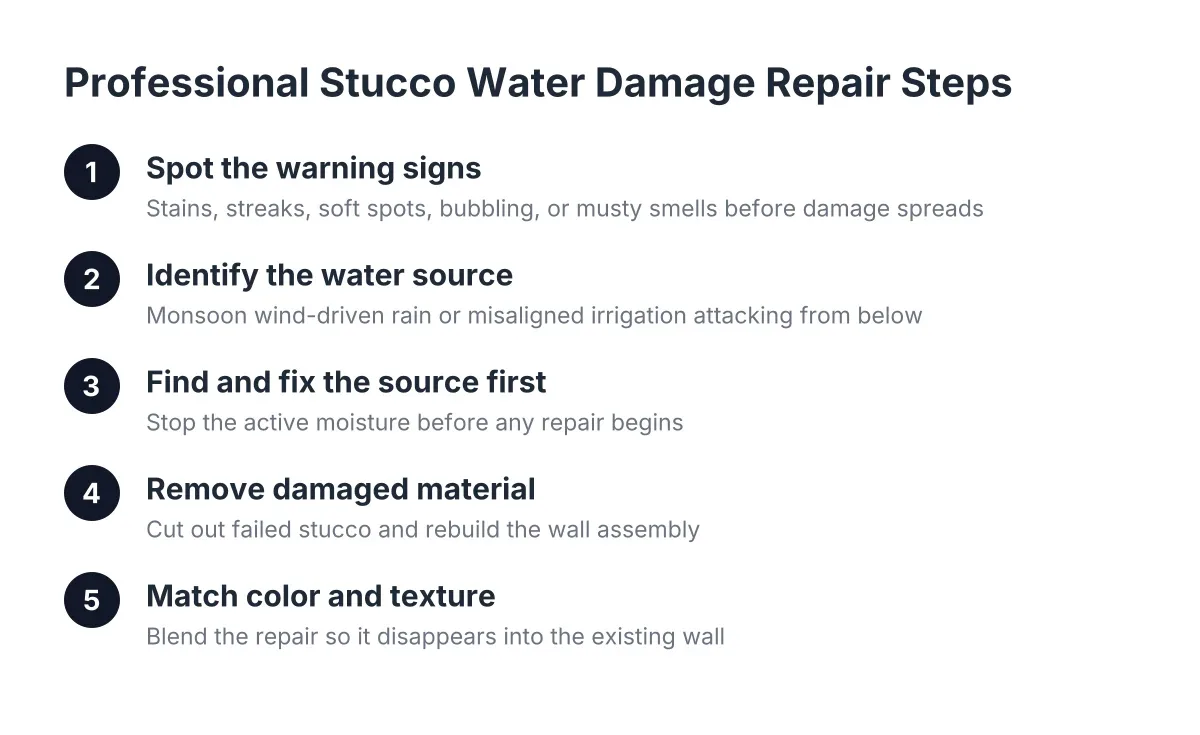
A real repair fixes three things: the source of the water, the damaged material, and the finished appearance. Skip any one of those and the problem returns. This is where most quick fixes fall apart, and it is worth understanding before you compare quotes or attempt a patch yourself.
Why patching over the stain fails
The tempting move is to seal the crack, skim the soft spot, and repaint. Unfortunately, that traps existing moisture inside the wall, where it keeps degrading the paper barrier and feeding mold. In practice, the failed patch shows up again within one or two monsoon seasons, and by then the underlying damage has grown. Scottsdale's heat accelerates this cycle, because rapid surface drying hides how wet the cavity still is. We break down the most common shortcuts and their costs in why DIY stucco water damage repair fails in Scottsdale. A correct repair opens the wall, dries it, replaces compromised barrier and stucco, and then rebuilds the coats so texture and color match the surrounding surface.
What the numbers look like
Cost depends on how far the water traveled, not just how big the stain looks. For context, Fixr.com puts the national average cost to repair stucco between $900 and $3,000, with a typical job around $1,700 for buckled three-coat stucco in a 10×10-foot area. Water damage repair can land below or above that range depending on whether framing or sheathing needs replacement. For Scottsdale-specific numbers and the three factors that move a quote up or down, see our water damage stucco repair cost guide.
Understanding the quotes you receive
Contractors will use terms like weep screed, scratch coat, lath, and weather-resistive barrier. You do not need to become an expert, but knowing the vocabulary helps you compare bids fairly and spot vague proposals. With this in mind, keep our plain-English glossary of repair terms open while you read estimates. A quote that names the water source and describes barrier replacement is usually more trustworthy than one that only mentions patching and paint. When you are ready to see how we handle the full process, our Scottsdale water damage stucco repair service page explains each step from leak detection to color and texture matching.
Ready to Get Started?
If you have spotted a stain, a soft patch, or a crack that keeps coming back, the smartest move is to have it assessed before the next monsoon season tests it again. We handle water damage repair for Scottsdale homeowners every week, and we can tell you quickly whether you are looking at cosmetic wear or an active leak. Reach out, describe what you are seeing, and we will help you figure out the right next step.