Arizona Climate Impact on Stucco: FAQ for Assessing Weathered Walls
If you are prepping a Scottsdale home for listing photos, or your HOA board just got a reserve-study report flagging cracks in the community perimeter walls, you are probably asking the same question: how bad is this, really? Understanding the Arizona climate impact on stucco is the first step, because our heat, monsoons, and dry spells cause a specific pattern of wear that looks alarming but often isn't. This article covers a stucco weathering assessment FAQ, walking through the most common questions homeowners and board members ask when they are assessing stucco before a repair, a sale, or a bid.
Why does the Arizona climate crack stucco in the first place?
Arizona's daily temperature swings make stucco expand in the afternoon heat and contract at night, and that constant movement opens hairline cracks over time. Add monsoon rain hitting sun-baked walls, and the wet-dry cycling accelerates the process. Cracking here is normal wear, not automatically a sign of a failing wall.
Stucco is a cement-based material, so it is rigid. When the wall assembly behind it flexes and the surface cannot, the stucco cracks at the weakest points. That is why you see cracks radiating from window corners, door frames, and hose bibs. Those spots concentrate stress every time the wall heats up and cools down.
Which parts of a stucco wall does Arizona weather hit hardest?
The Arizona climate impacts stucco unevenly. South- and west-facing walls take the most direct sun, so they fade, chalk, and crack faster than shaded sides. Areas near the foundation, around windows, and at outside corners are the next most common trouble spots.
Here is where to focus your assessment first:
- South and west walls: color fading and hairline cracking from direct sun exposure
- Window and door corners: diagonal stress cracks from thermal movement
- The base of the wall: water damage where monsoon runoff or irrigation pools against the foundation
- Outside corners near AC units: vibration from mechanical equipment can loosen and crack stucco over time
- Shaded, damp spots: staining or organic growth where walls stay wet after rain
If a corner crack sits where the stucco meets a concrete foundation, that is usually a minor issue. The harder foundation and softer stucco expand at different rates, and the crack forms at the boundary. It should still be sealed, but it is rarely structural.
How can I tell if a crack is cosmetic or serious?
Width and pattern are your two best indicators. Hairline cracks under about a sixteenth of an inch, especially the spider-web kind, are cosmetic weathering and a straightforward stucco crack repair. Cracks wider than a credit card, cracks that run in long diagonals, or cracks with offset edges deserve a professional look.
Also check whether the crack is stable. Suppose a homeowner in North Scottsdale photographed a window-corner crack in March and it measured the same in September; that crack is likely thermal movement, not settlement. A crack that keeps widening is telling you the wall is still moving, and the cause needs to be found before patching.
Stucco Weathering Assessment: What's Behind Your Wall?
Behind a typical Arizona stucco wall sits a moisture barrier of building paper, then metal lath or wire fastened over it, then the stucco itself applied in coats. The paper is the real waterproofing; the stucco is the armor over it. Assessing stucco means asking whether that paper is still intact.
However, building paper gets brittle with age. Decades of heat bake it, and repeated monsoon wetting hardens it further, the way material dries out in an oven. If a structural crack sits open for years, wall flexing can tear that brittle paper, and then water gets into the framing. This is why an old, ignored crack is a bigger risk than a new one of the same size.
How does Arizona's climate impact stucco compared to wetter states?
The Arizona climate impact on stucco is mostly thermal and UV-driven, while wetter climates fight constant moisture. Here, cracks come from expansion and contraction; there, walls rot from trapped water. The good news is that Arizona's dry air gives stucco a long service life when cracks get sealed promptly.
Stucco remains the dominant wall material in this region for a reason. According to the National Association of Home Builders, stucco was used on 48% of new single-family homes started in the Mountain division in 2024, which includes Arizona. It handles heat well. The maintenance job is simply to keep the weather out of the cracks the heat creates.
Can I check my own stucco before calling anyone?
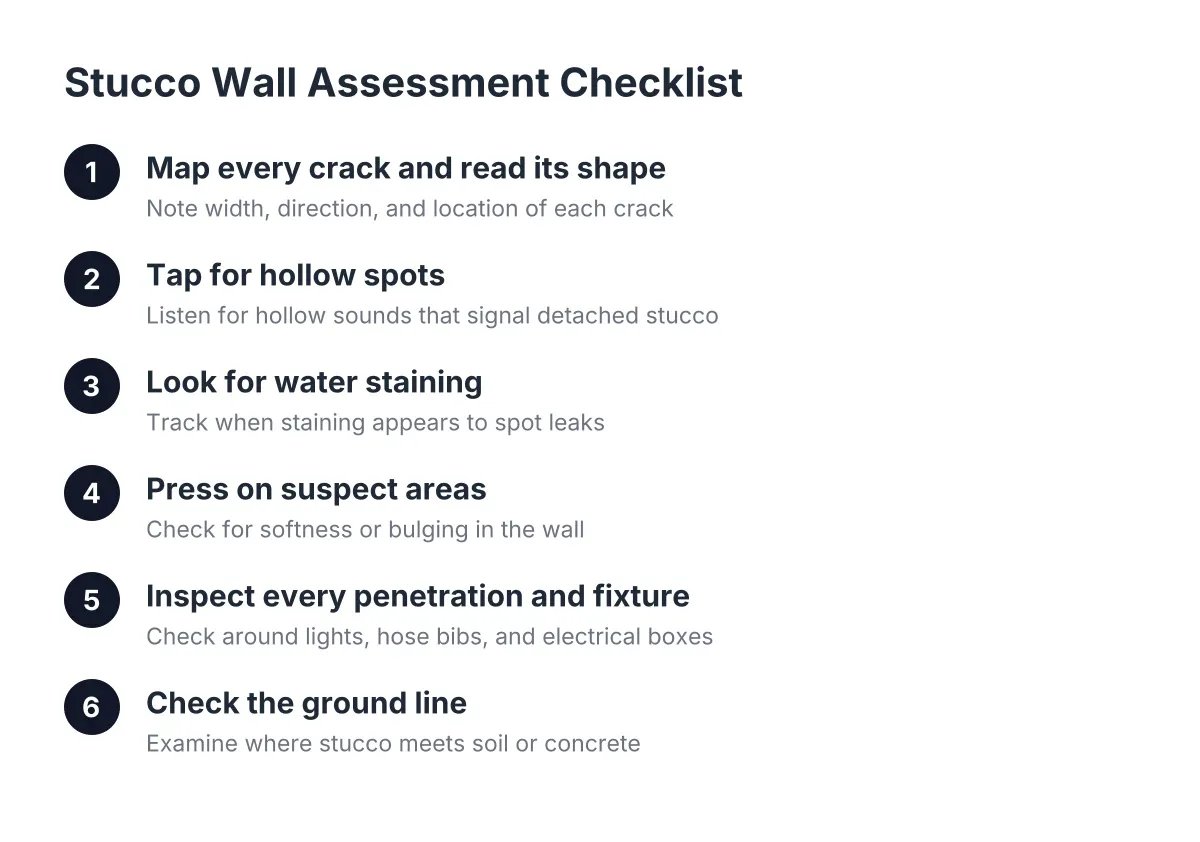
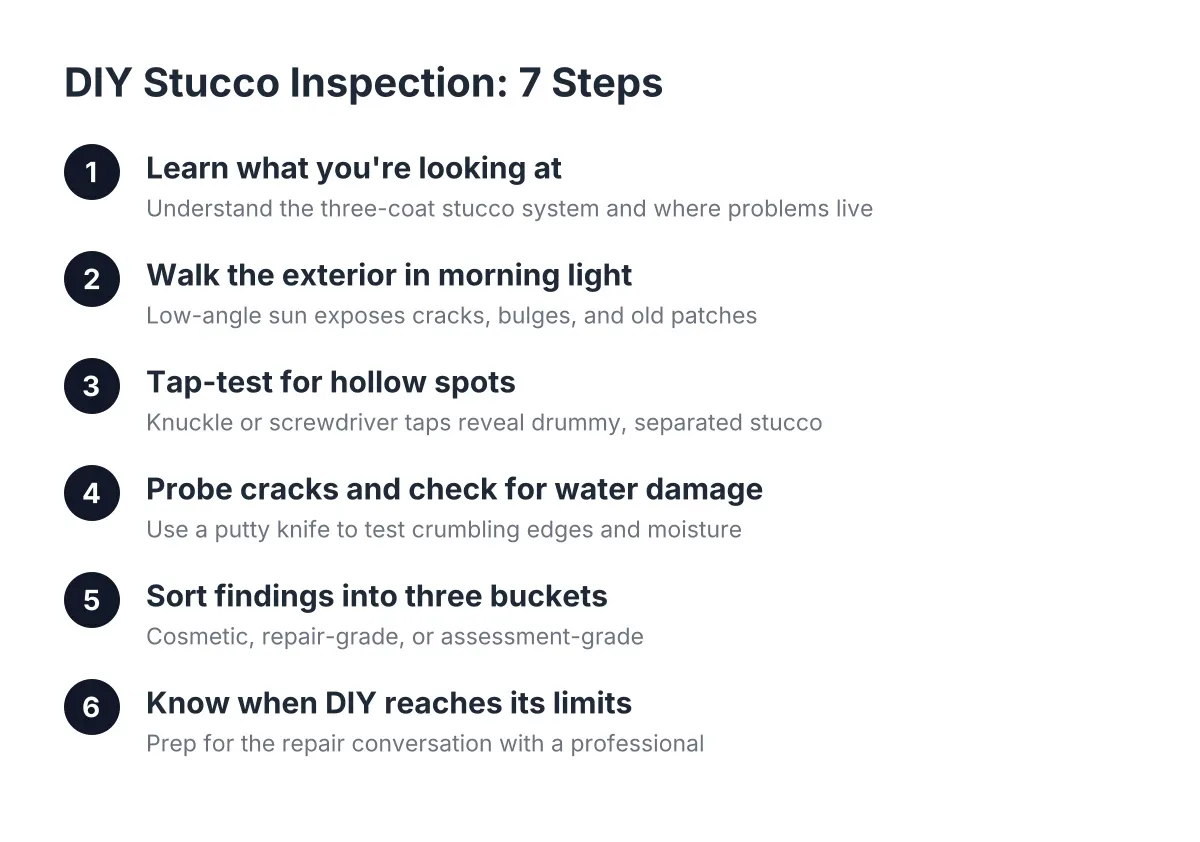
Yes, and a careful walk-around tells you most of what a first assessment would. Tap the wall with your knuckles in several spots. A solid sound means the stucco is bonded; a hollow sound means it has detached from the substrate and needs professional repair, not just surface patching.
Beyond the tap test, walk the exterior in morning light, when raking sun makes cracks and old patch lines easy to see. Photograph everything, measure crack widths, and note any soft, stained, or bulging areas near the base of the wall. When you are completing a stucco weathering assessment FAQ walkthrough, check thickness, layers, and moisture step by step.
One caution: do not pressure wash cracked stucco to clean it up before photos. High-pressure water forces moisture behind the layers, and trapped moisture can turn a cosmetic problem into a structural one.
Will a repair patch match the rest of my sun-faded wall?
A patch can blend in, but only if the repair includes stucco color matching and texture matching against the faded wall, not against the original color. Arizona sun fades pigment unevenly, so matching a 15-year-old west wall means matching what the sun left behind. A patch tinted to the original color will read as a bright rectangle in listing photos.
Texture matters as much as color. Scottsdale homes carry everything from smooth santa-fe finishes to heavy lace, and a patch troweled in the wrong texture shows even when the color is right. If you are fixing stucco before selling the house, ask specifically how the contractor matches both, and expect them to test a small area first. In some cases, resurfacing or repainting a full wall section is the honest answer when a spot patch cannot blend.
Should I use a DIY product like Quikrete for crack repair before listing?
For hairline cracks on a wall you plan to repaint entirely, a Quikrete stucco crack repair product or similar sanded caulk is a reasonable stopgap. For anything visible in photos on an unpainted wall, DIY fillers tend to dry smooth and shiny against textured stucco, which draws the eye more than the crack did.
Therefore, match the fix to the stakes. A seller three weeks from photos, or an HOA presenting a perimeter wall to a reserve inspector, usually gets a better outcome from professional patching with texture and color matched. As a rough national benchmark, Fixr.com puts stucco repair at $900 to $3,000, averaging about $1,700 for a 10×10-foot area of buckled three-coat stucco. Small crack repairs often cost far less; the assessment tells you which situation you have.
What should an HOA board look at on community stucco walls?
Perimeter walls and entry monuments take Arizona weathering with none of the shade or roof overhangs a house gets, so they crack faster. Board members should walk shared walls once a year, ideally after monsoon season, and log crack locations, widths, and any staining at the base where irrigation or drainage pools.
In addition, document everything with dated photos. Say a 200-unit community finds recurring cracks along a south-facing perimeter wall; when conducting a stucco weathering assessment FAQ comparison across two inspection cycles, you can see whether the cracks are stable or spreading, which changes the repair scope and the bids. That record also gives the board what it needs to compare quotes on equal footing and vote with confidence.
When is weathering bad enough to need replacement instead of repair?
Repair handles most Arizona weathering: cracks, holes in a wall, small delaminated patches, and localized water damage near the base. Replacement or full resurfacing enters the conversation when large areas sound hollow, the surface is crumbling across a whole elevation, or water has been getting behind the stucco long enough to damage the paper and lath.
That call requires opening up a test section, so it is not a judgment to make from the surface alone. If your walk-around finds widespread hollow spots, soft areas, or cracks that returned after previous repairs, bring in a professional before committing to either path. Guessing wrong in either direction, patching a failing wall or replacing a repairable one, is the expensive mistake this assessment exists to prevent.
If you need stucco repair, Scottsdale Stucco Repair can help.
Related guide: Stucco Wall Assessment — Complete Guide
Prefer to talk it through? Call (480) 637-3464 — a quick call is usually the fastest way to get a straight answer for your situation.