Best Stucco Resurfacing Materials: Acrylic, Cement, and Polymer Compared
If your Scottsdale home's stucco is faded, hairline-cracked, or patched in three slightly different colors, you have probably heard two options: paint over it or tear it all off and replace it. There is a third option most contractors skip past, and the best stucco resurfacing materials make it work. Resurfacing puts a new finish layer over structurally sound stucco, hiding old patches, blending mismatched colors, and giving the whole wall one uniform texture for a fraction of replacement cost. The material you choose—acrylic, cement, or stucco polymer-modified—decides how the wall looks, how long it holds, and what you pay.
This guide compares those three material families in plain terms. If you are prepping a house for listing photos, or you are finishing an addition and need the new stucco to blend with the original walls, the material choice matters more than most homeowners realize.
Why Resurfacing Gets Skipped and Why It Shouldn't
Resurfacing sits in an awkward middle spot. It is a bigger job than caulking a crack, so handyman-type outfits pass on it. It pays less than a full tear-off, so replacement-focused crews rarely bring it up. That leaves a lot of Scottsdale homeowners choosing between a cheap fix that shows and an expensive replacement they do not need.
Here is the honest test. If your stucco is bonded tight to the wall, with no large hollow areas, no rot behind it, and no structural cracks wider than a credit card, the base coats are still doing their job. What failed is the finish: sun-faded color, chalking, hairline crazing, and old patches that never matched. Resurfacing replaces that finish layer without disturbing the sound material underneath.
For context, stucco is not a niche finish here. According to National Association of Home Builders, stucco remained the most-used exterior wall material in the Mountain division, which includes Arizona, at 48% of new single-family homes started in 2024. Half the houses on your street likely face the same fading and cracking timeline yours does. The difference between homes that photograph well and homes that look tired often comes down to whether the finish coat was ever refreshed.
What the Best Stucco Resurfacing Materials Have in Common
The best stucco resurfacing materials share three traits regardless of chemistry: they bond hard to cured stucco, they flex enough to bridge hairline cracks without reopening them, and they carry integral color and texture so the finish is the wall, not a coating sitting on top of it.
Bond strength comes first. A resurfacing coat that peels or delaminates looks worse than the faded wall it covered, and it usually fails at the exact patches you were trying to hide. That is why surface prep matters as much as the product; loose burrs, chalky residue, and rough spots get scraped and cleaned off before anything goes on, so the new coat grabs clean, solid stucco.
Flexibility comes second. Scottsdale walls swing through big daily temperature changes, and stucco expands and contracts with them. A rigid coating over a moving wall cracks along the same lines the old finish did. Modern acrylic and polymer-modified products handle that movement far better than plain cement.
Texture is the third trait, and the one pre-sale sellers care about most. Stucco's texture is what hides imperfections underneath. A resurfacing material that can be floated, troweled, or dashed to match your existing finish, whether that is sand, lace, or smooth, is what makes old patches disappear instead of telegraphing through.
Acrylic, Cement, and Stucco Polymer-Modified: The Three Material Families Compared
Acrylic finishes: the color and flexibility pick
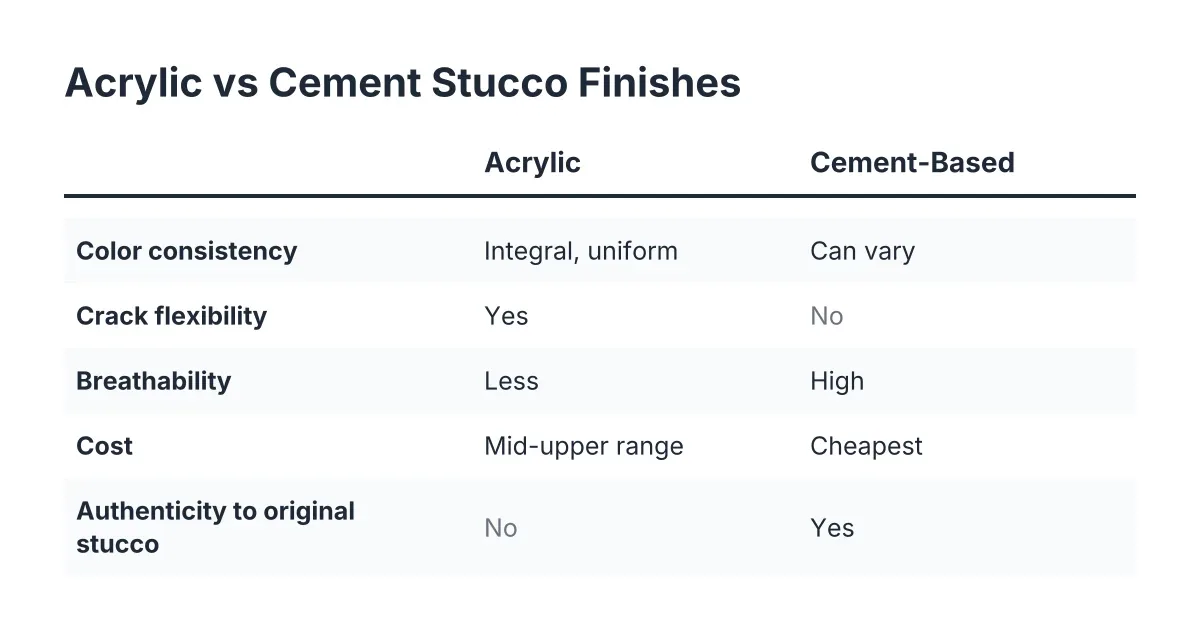
Acrylic stucco finishes are factory-mixed, pre-colored coatings applied as a thin finish layer, usually about a sixteenth of an inch, over prepared stucco. The color is integral and consistent bucket to bucket, which is why acrylic is the go-to when color matching is the whole point of the job.
For the seller whose previous patch never matched, this is usually the answer. Instead of trying to blend one patch into thirty-year-old faded color, an acrylic finish recolors the entire wall plane in one uniform tone. Every patch, stain, and touch-up vanishes under one consistent surface. In listing photos, the wall reads as freshly maintained rather than repaired.
Acrylics also flex. They bridge hairline cracks and move with the wall through Arizona's heat cycles, so those spider cracks around your windows are far less likely to reappear through the new finish. The trade-off is breathability; acrylic sheds water well but lets less moisture vapor escape than cement. On a wall with an unresolved water problem, that trapped moisture can cause trouble, which is why water damage gets fixed before resurfacing, not covered by it.
Cost lands in the middle to upper range of resurfacing options. Acrylic buys you the best color control and crack-bridging of the three families, and for a pre-listing refresh that has to photograph well, that is usually money well placed.
Cement-based finishes: the traditional, budget-friendly pick
Cement-based resurfacing, often called a skim coat or a new color coat, is the traditional approach. It is a sand-and-cement finish, sometimes with integral pigment, troweled over the existing wall the same way the original finish coat went on. Traditional stucco was built in three coats, a scratch coat, a brown coat, and a finish coat; a cement skim coat replaces that finish layer in kind.
The strengths are cost, breathability, and authenticity. Cement is the cheapest material of the three, it lets the wall breathe so moisture vapor escapes naturally, and it produces the same look and feel as original stucco because it is the same material. On an older Scottsdale home with a traditional sand finish, a cement skim coat is often the most faithful match.
However, cement is rigid. It does not bridge cracks; if the wall moves, hairline cracks can reflect through the new coat within a year or two. Integral cement color also cures with natural variation, so exact color matching is harder than with factory-tinted acrylic. Many cement resurfacing jobs get painted afterward with masonry paint to lock in a uniform color, which adds a maintenance cycle acrylic avoids.
When comparing acrylic versus cement stucco finishes, cement is the choice when budget leads, when the wall is stable with no active cracking, or when you want a traditional finish that will later be painted anyway.
Polymer-modified cement: the middle ground and repair workhorse
Polymer-modified materials are cement-based products with acrylic polymers blended in. The polymers make the mix stickier and more flexible than plain mortar; the material grips vertical surfaces and hangs without sagging, which is exactly what a resurfacing coat needs to do. Some rapid-setting polymer-modified patch products can even replace the old three-coat buildup with a single application on repair areas, so deeper damage gets rebuilt in one pass before the finish goes on.
In practice, polymer-modified material is the workhorse of the prep stage on nearly every resurfacing job. Before any finish coat, holes get filled, wide cracks get routed and packed, and low spots get leveled, and polymer-modified compound handles all of it. On a wall that needs stucco patching and resurfacing together, which describes most pre-sale jobs, this material does the heavy lifting and the acrylic or cement finish provides the final look.
As a standalone finish, polymer-modified skim coats split the difference: more flex and better adhesion than plain cement, more breathability than full acrylic, and moderate cost. The main limitation is color; like cement, most polymer-modified finishes rely on site-mixed pigment or a topcoat rather than factory tinting, so precise color matching takes more skill.
Matching Materials to Your Situation
The right pick depends on why you are resurfacing. Here is the short version:
- Selling soon and the wall has mismatched patches: acrylic finish over polymer-modified crack and patch prep. One uniform color, crack-bridging flex, photographs clean.
- Older home, traditional finish, tight budget: cement skim coat, painted afterward if you want dead-even color.
- Wall has holes, wide cracks, or old failed patches: polymer-modified repair compound first, in every scenario, then the finish coat of your choice.
- New addition that must blend with the original house: finish material chosen to match the existing wall's chemistry and texture, usually cement or polymer-modified for older homes and acrylic where the original finish was acrylic.
- Active water damage, bulging, or hollow-sounding stucco: stop; that section needs repair or replacement before any resurfacing material goes on.
That last point deserves emphasis. Resurfacing is a finish fix, not a structural one. Covering water-damaged or delaminating stucco with a new coat hides the evidence for one season and then fails, often right before the timing you were protecting. A five-minute tap test across the wall, listening for hollow spots, is the cheapest insurance in this whole process, and it is worth having a stucco professional do that assessment before you commit to a material.
Does Resurfacing Fix Cracks?
Resurfacing fixes hairline cracks permanently when the material flexes and the cracks are cosmetic. Fine surface crazing and shrinkage cracks disappear under an acrylic or polymer-modified coat and stay gone, because those materials bridge minor movement. Wider or structural cracks need individual repair first; no finish coat, whatever the material, reliably holds a moving crack shut.
The dividing line is width and cause. Cracks you can barely catch a fingernail in are finish-level and resurface cleanly. Cracks wide enough to hold a coin edge get opened, filled, and reinforced before the finish coat; on deeper joints, a foam backer rod goes into the gap first to give the sealant a proper foundation, a standard practice noted by Sika. Diagonal cracks running from window corners, or cracks that keep growing, point to movement in the structure and need diagnosis, not covering.
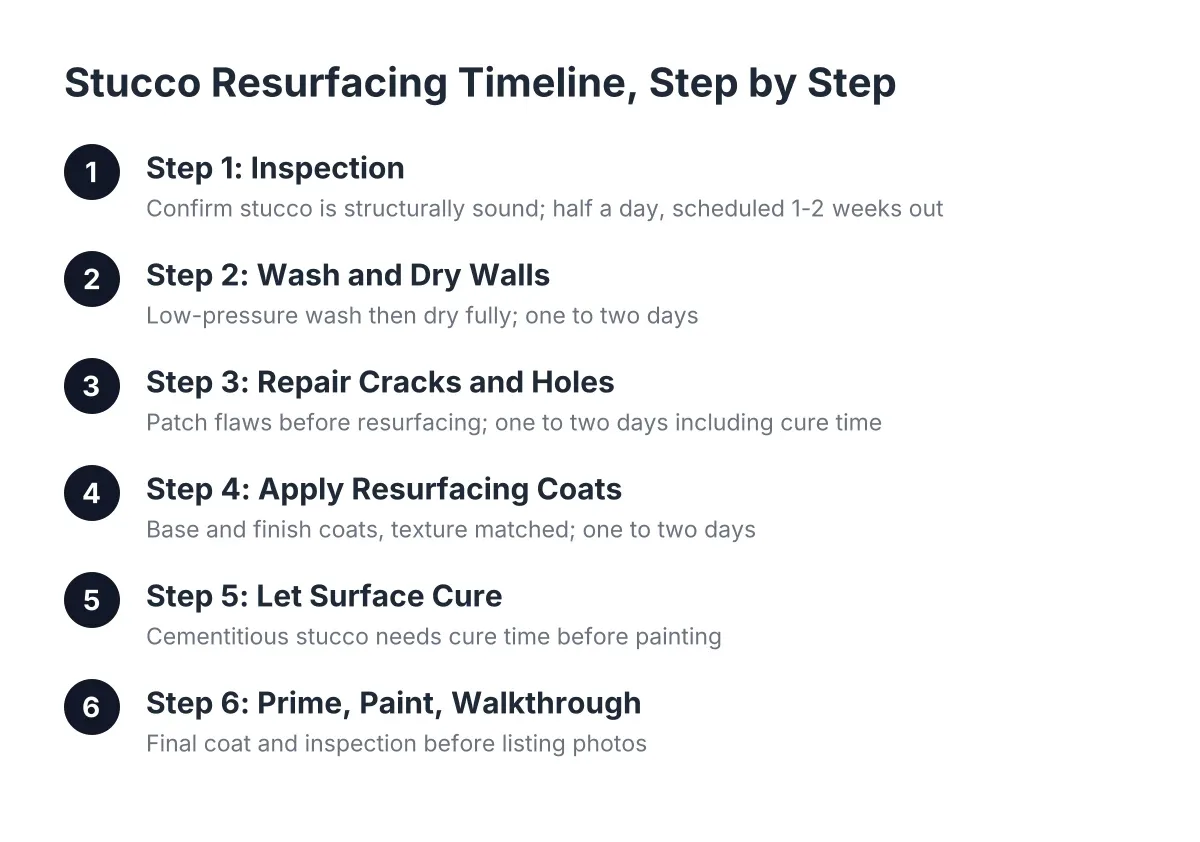
Suppose a homeowner in north Scottsdale is listing in six weeks. The realtor flagged spider cracking around three window corners and a fist-sized patch by the garage that dried two shades lighter than the wall. In that scenario, a typical approach is polymer-modified compound on the cracks and patch in week one, an acrylic finish coat over the affected elevations in week two, and full cure with stable color well before the photographer shows up. The materials, not the schedule, are what make that timeline realistic; cement alone would need a paint step and more cure time to hit the same uniform look.
Cost: Where Resurfacing Materials Land Against Repair and Replacement
Resurfacing material costs scale with what the product does. As a rough 2026 illustration, plain cement finish is the least expensive per square foot, polymer-modified sits in the middle, and factory-tinted acrylic costs the most, though on a whole-wall job labor still outweighs material for all three. Treat those as ballpark relationships, not quotes; wall condition and texture complexity move the number more than the bucket price does.
For scale, spot repair alone runs a national average of $900 to $3,000, about $1,700 for repairing buckled three-coat stucco in a 10×10-foot area, according to Fixr.com. Resurfacing a full elevation costs more than one patch but dramatically less than tearing off and rebuilding all three coats, because the base layers stay in place. That is the entire economic argument for Stucco Resurfacing as the middle option: you pay for a new finish, not a new wall.
For a seller, the math tilts further. A wall of visible cracks and mismatched patches invites inspection notes, appraisal remarks, and buyer discounts that dwarf the resurfacing bill. Spending on a finish coat that makes the exterior read as maintained is one of the few pre-sale repairs buyers actually see in every photo.
How to Judge Which Resurfacing Materials Are Best for Your Wall
The best stucco resurfacing materials for your specific wall come down to five questions any contractor should answer before quoting. Ask them directly:
- Is the existing stucco sound? Tap testing and a visual check for bulges, staining, and wide cracks come before any material talk.
- What is the existing finish? Acrylic goes over acrylic cleanly; cement over cement is traditional; crossing systems takes the right primer and prep.
- How exact does the color match need to be? Factory-tinted acrylic for photo-critical uniformity, integral cement color plus paint when close-enough works.
- How much movement does the wall see? Recent cracking history favors flexible acrylic or polymer-modified over rigid cement.
- What happens to the rest of the house? Resurfacing one elevation in a new color can make the other three look worse; plan the whole exterior, even if you phase the work.
A contractor who jumps straight to full replacement without walking through these questions is quoting the job that pays them most, not the job your wall needs. Equally, a painter who offers to roll elastomeric paint over failing patches is selling you a one-season fix. The material conversation is how you tell the difference.
The Bottom Line
Resurfacing works when the wall underneath is sound and the finish is what failed, and in Scottsdale that describes most tired-looking stucco. Acrylic buys the tightest color match and crack-bridging flex, which makes it the default for pre-sale refreshes. Cement is the budget-friendly traditional route for stable walls headed for paint. Polymer-modified compounds are the repair backbone under either finish and a capable middle-ground finish on their own.
Get the wall assessed honestly first, pick the material that fits your cracking history and color needs, and you get a wall that looks new for a finish-coat price. That is the option the tear-off quotes never mention, and for most homeowners staring at faded, patched stucco, it is the one worth pricing first.
If you need stucco repair, Scottsdale Stucco Repair can help.
Prefer to talk it through? Call (480) 637-3464 — a quick call is usually the fastest way to get a straight answer for your situation.